
Basic vs Enhanced DBS Check: Choosing the Right Level for Your Role
When it comes to DBS checks, one of the most common questions employers and individuals ask is: which level do I actually need? Choosing the wrong check type can cause delays, wasted costs, or worse — a compliance gap that puts your organisation at risk.
This guide breaks down the difference between a Basic, Standard, and enhanced DBS check, explains when each level is legally required, and helps you make the right decision for every role in your organisation.
Visit APCS Criminal Record Checks
Table of Contents
- Understanding the Three Levels of DBS Checks
- Eligible Roles: When an Enhanced DBS Check Is Legally Required
- Cost vs Value: Avoiding Over-Checking
- Common Role Examples and Their Required Check Levels
- What to Do If You’re Asked for the Wrong Level of Check
- Final Thoughts
Understanding the Three Levels of DBS Checks
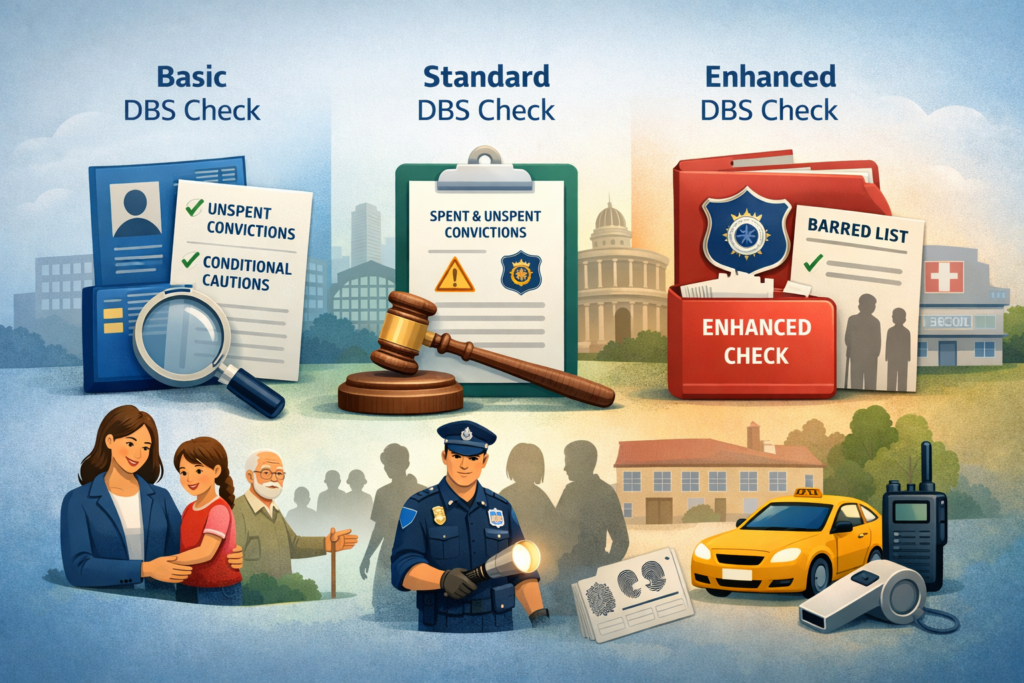
The Disclosure and Barring Service (DBS) offers three levels of criminal record check. Each reveals a different amount of information and is suited to different types of role.
Basic DBS Check
A Basic DBS check is the entry-level check, available to any individual or employer regardless of the role. It shows only unspent convictions and conditional cautions — meaning any criminal record that is still active under the Rehabilitation of Offenders Act 1974.
Basic checks are not restricted to specific roles and can be requested by anyone. They are commonly used for roles that do not involve working with children or vulnerable adults. Find out more about our Basic DBS check service.
Standard DBS Check
A Standard DBS check shows both spent and unspent convictions, cautions, reprimands, and warnings held on the Police National Computer. This level is only available for certain roles — primarily those in the legal and financial sectors, or roles listed in the Rehabilitation of Offenders Act 1974 (Exceptions) Order 1975. Find out more about our Standard DBS check service.
Enhanced DBS Check
An enhanced DBS check is the most thorough level available. In addition to everything shown on a Standard check, it can include relevant information held by local police forces that is considered relevant to the role. For roles involving regulated activity with children or vulnerable adults, it also includes a barred list check.
Enhanced DBS checks are reserved for roles involving a high level of contact with children or vulnerable adults, or specific positions listed in legislation. Find out more about our Enhanced DBS check service.
Eligible Roles: When an Enhanced DBS Check Is Legally Required
An enhanced DBS check is not available for every role — it is only permitted where the position meets specific legal criteria. The two key concepts here are regulated activity and eligibility under the Rehabilitation of Offenders Act 1974 (Exceptions) Order.
What is Regulated Activity?
Regulated activity refers to specific types of work with children or vulnerable adults that cannot be carried out by barred individuals. If a role involves regulated activity, an enhanced DBS check with a barred list check is legally required.
Examples of regulated activity with children include:
- Teaching, training, or supervising children
- Care or supervision of children in a school, nursery, or childcare setting
- Driving a vehicle for children as part of employment
- Any overnight activity involving children
For a full list of activities that constitute regulated activity, see our regulated activity reference document.
What About Non-Regulated Roles?
Some roles involve contact with children or vulnerable adults but do not meet the threshold for regulated activity. These roles may still be eligible for an enhanced DBS check without a barred list, depending on the frequency and nature of contact.
If a role does not meet the criteria for a Standard or enhanced DBS check, a Basic DBS check is the appropriate option. Requesting a higher level than legally permitted is not allowed.
You can also read more about regulated activity and DBS eligibility on the official Disclosure and Barring Service website.
Cost vs Value: Avoiding Over-Checking
One of the most common and costly mistakes organisations make is defaulting to an enhanced DBS check for every role, regardless of whether the position legally qualifies. This leads to unnecessary expenditure and, in some cases, requests that the DBS will reject.
As of 2026, APCS DBS check fees are:
| DBS Check Type | APCS Fee |
|---|---|
| Basic DBS Check | £34.70 |
| Standard DBS Check | £34.70 |
| Enhanced DBS Check | £62.70 |
For organisations running dozens or hundreds of checks per year, the difference between a Basic and an enhanced DBS check adds up significantly. Selecting the correct level from the outset is one of the most effective ways to manage your background screening budget.
At APCS, there are no registration fees or annual charges — you pay only for the checks you need. Find out more about our DBS check pricing.
Common Role Examples and Their Required Check Levels
To help clarify whether a Basic, Standard, or enhanced DBS check is required, here are real-world examples across sectors:
| Role | Required Check Level |
|---|---|
| Teacher or teaching assistant | Enhanced DBS check with barred list |
| School caretaker or cleaner (unsupervised access) | Enhanced DBS check |
| Care worker in a residential setting | Enhanced DBS check with barred list |
| NHS healthcare professional | Enhanced DBS check with barred list |
| Solicitor or barrister (upon entry into the profession) | Standard DBS check |
| Office administrator (no vulnerable contact) | Basic DBS check |
| Foster carer | Enhanced DBS check with barred list |
| Sports coach working with children | Enhanced DBS check with barred list |
| Taxi or private hire driver | Enhanced DBS check (licensing requirement) |
If you are unsure which level applies to a specific role, contact the APCS team for guidance.
What to Do If You’re Asked for the Wrong Level of Check
Occasionally, applicants are asked by an employer to obtain a higher level of DBS check than their role legally requires. This is more common than many people realise and can happen for several reasons — most often because an organisation has not reviewed its checking policy in line with current guidance.
If You Believe You Have Been Asked for the Wrong Check
- Ask your employer to confirm in writing why the check level was selected and what legislation it is based on
- Check the DBS eligibility guidance on the GOV.UK website to verify whether the role qualifies
- If you believe an enhanced DBS check has been requested for a role that does not qualify, you are entitled to raise this with the DBS directly
If You Are an Employer Reviewing Your Checking Policy
It is worth auditing your current roles periodically to ensure you are requesting the correct level of check for each position. This not only keeps you compliant but also reduces unnecessary costs across your organisation. For support reviewing your checking process, explore APCS criminal record check services.
Final Thoughts on Basic vs Enhanced DBS Checks
Choosing the right DBS check level is not just a compliance issue — it is a practical and financial one too. Selecting a Basic DBS check where an enhanced DBS check is required leaves your organisation exposed. Selecting an enhanced DBS check where a Basic would suffice wastes budget and can result in rejected applications.
The key questions to ask for every role are:
- Does this role involve regulated activity with children or vulnerable adults?
- Is the role listed in the Exceptions Order as eligible for a Standard or enhanced DBS check?
- What level of check is proportionate to the nature and frequency of contact involved?
If in doubt, APCS is here to help. With no registration fees and over 19,000 organisations already trusting us for their DBS checks, we make the process straightforward from start to finish.
0343 611 2727
criminalrecordchecks.co.uk